

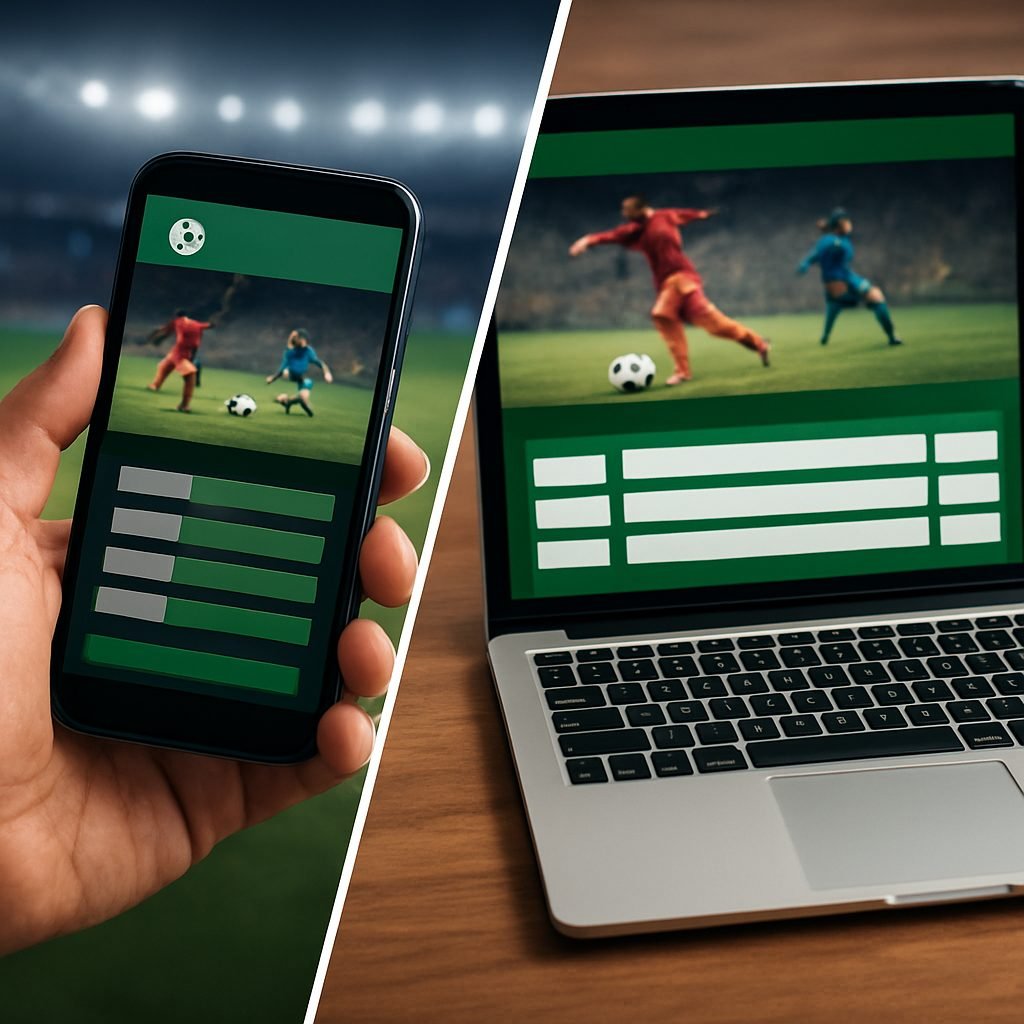
Soccer Betting Apps vs. Desktop Platforms: Which Delivers a Better Experience
Choosing the right soccer betting app versus a desktop platform matters more than you think – it changes speed, market visibility, and whether you catch or miss critical in-play opportunities. This piece compares navigation, live betting performance, security and payments, promotions, and responsible gambling features, and includes a practical checklist you can use to test GGLBET and other operators side-by-side. Read on to find which platform suits your betting persona – on-the-go casual, live specialist, research-driven punter, or multi-market pro – and how to run a short reality test before you commit.
1. How bettors use a soccer betting app versus a desktop platform
Direct observation: most bettors pick the platform that fits the session length and decision complexity. A soccer betting app wins on short, decisive actions and live in-play needs. Desktop wins when the user needs space, comparison tools, and deliberate building of multi-leg wagers.
Four practical user personas
- On the go casual bettor: quick checks between errands, places single prematch or small accumulator bets, expects one-tap stake entry, push notifications, and fast deposit options.
- Live in-play specialist: focuses on in-match momentum swings, needs instant odds updates, fast cash out, and minimal taps to lock a bet; mobile apps are common here for speed and streaming.
- Research driven prematch bettor: runs statistics, compares markets, builds complex bet builders and accumulators across leagues; prefers desktop with multiple tabs, spreadsheets, and a larger odds grid.
- Professional multi-market bettor: tracks many matches simultaneously, uses multiple screens or windows, relies on low-latency feeds and trading tools; desktop is near universal in this group.
Session patterns matter. Short sessions under 10 minutes map well to a soccer betting app. Sessions that include data pulls, line shopping across tabs, or manual modelling push bettors toward desktop. Expect the mobile session to be transactional and the desktop session to be investigative.
Tradeoff to accept: mobile reduces friction but concentrates attention. That is good for seizing in-play opportunities, and bad when it encourages impulsive wagers or prevents cross market checks. Desktop reduces impulse risk by making multi-source checks easier, but it also increases time to act on a fast-changing live event.
Concrete example: a live in-play bettor following a Champions League match will typically use a football betting app like FanDuel or DraftKings to receive a push when a corner is awarded, open the app, and place a single in-play bet within seconds. A data-driven bettor preparing an accumulator across five leagues will use Bet365 on desktop to view full match stats, compare Asian handicap lines, and build the bet slip while keeping multiple tabs open.
Practical limitation: screen real estate on mobile constrains simultaneous market visibility. If you track more than three markets closely you will lose situational awareness on an app. That matters for hedging, partial cash out decisions, and managing correlated outcomes in accumulators.
Testing step for readers: try a 48 hour comparison. On day one use the soccer betting app exclusively for live in-play bets and note time to place, cash out speed, and any rejected stakes. On day two use desktop for your prematch workflow and note how many markets you can monitor without losing track. Record which platform cost you a missed opportunity.
Where to look for evidence: mobile usage dominates global sports betting traffic according to Statista. For local rules and safety expectations check the Gambling Regulatory Authority of Singapore. If you want to test GGLBET side by side, start with a simple checklist and consult GGLBET editorial and correction policies at editorial policy.
2. Navigation, market discovery, and bet placement flow
Direct point: A well-designed soccer betting app trades screen real estate for speed; the question is whether that speed preserves enough market visibility to make good wagers. Mobile flows win for single, fast bets; desktop wins when you need to compare dozens of markets before you pull the trigger.
What to measure in the flow
Key metrics: Count taps or clicks, measure time from market select to bet confirmation, and note how many markets you can view on a single screen. Acceptable thresholds in practice: under 6 taps for a prematch single, and under 3–4 seconds from tap to confirmed in-play wager on a reliable network.
- Search and filter accuracy: Can you find Asian handicap, total goals, and correct score quickly? A good soccer odds app surfaces market groups and supports quick text search.
- Bet slip behavior: Does the slip persist when you switch screens? Can you lock a stake, use presets, or undo a change?
- Market comparison: Can you view multiple markets or head-to-head odds easily, or do you have to drill into each match?
- One-tap actions and safety: Are there one-tap bet options and do they include protective confirmations to avoid accidental wagers?
Trade-off to accept: Mobile design pushes features behind menus; that reduces clutter but increases cognitive cost if you are scanning many matches. If your betting style is to monitor several simultaneous markets, a desktop layout with columns and persistent bet builder will save you time and money despite slower single-action speed.
Concrete example: A live in-play bettor using a football betting app sees a red card and wants a quick over/under bet. With stake presets and one-tap acceptance the bettor can locate the market, apply a 0.5 preset stake, and confirm within three taps and three seconds. That workflow works only if the app keeps the bet slip persistent and does not force a full page reload when odds change.
Common mistake operators and users make: Relying on one-tap betting without visible confirmations. It looks efficient on paper but in practice it increases accidental bets and disputes. Good apps offer configurable quick-bet toggles and clear timestamps on accepted odds so you can audit a fast in-play wager.
Practical checks to run in 10 minutes
- Open the same match on app and desktop; count taps/clicks to place a single prematch bet.
- Trigger an in-play market update (e.g., wait for a goalscorer or card) and measure time to confirm a one-click in-play bet.
- Test search: type a market name like Asian handicap and time how long until relevant markets appear.
- Try multi-bet building: add three different markets and note how the combined slip looks and whether odds recalculation is clear.
If you value speed for live soccer betting, prioritize apps with stake presets, persistent bet slips, and configurable quick-bet toggles. If you value market depth and side-by-side comparisons, use desktop.
Next consideration: Run the simple 10-minute checks on GGLBET app and desktop yourself. Use Tennis Betting Online | Bet Live Now | GGLBET SG for layout clues and compare how quickly the soccer markets appear and how the bet slip behaves under rapid odds changes. This narrow test tells you more than vendor claims.
3. Live in-play betting and streaming: latency, odds updates, and cash out
Latency and feed freshness decide winners in live soccer betting. A soccer betting app can shave taps and display push updates, but the critical metric is end-to-end latency – the time from a real-world event to the moment your client shows new odds and will accept a wager.
Latency is not one thing. It is a chain: the data provider sees the event, the odds engine recalculates, the operator pushes the update to servers, your device receives it, and finally the bet acceptance endpoint confirms the stake. Any slow link in that chain turns a one-tap cash out into a declined or stale offer. Network type, geographic routing, and server load matter as much as app design.
Practical tests to measure in-play performance
- Measure odds update latency: pick a high-event match, note an objective clock event (goal or red card), and timestamp when odds change on both mobile and desktop under the same network.
- Time to place and accept: start the timer when you tap the market and stop when the bet confirmation arrives. Repeat 10 times and record mean and failure rate.
- Cash out reliability: trigger a small partial cash out and note whether the offered amount differs between platforms and whether the action succeeds or returns stale pricing.
- Network control: run tests on the same Wi Fi and on mobile data. Compare wired desktop Ethernet against phone on the same Wi Fi to remove device wireless variance.
Live streaming reduces perceptual latency but does not guarantee faster odd updates. Some operators prioritize app streaming for rights or codec reasons, which helps traders react visually, but streaming can also add bandwidth contention that slows odds refresh on congested connections. If you rely on seeing the match feed for in-play calls, test whether the stream lags or leads the odds feed on both platforms.
Cash out is a UX and timing problem. Apps commonly expose one-tap full cash out and simplified partial sliders. Desktop interfaces tend to show exact exposure and partial percentages more clearly, which helps when you want to scale a partial exit across multiple bets. In practice, the app gives speed; desktop gives control. If the operator uses an acceptance queue, fast taps on mobile can still fail because the server blocks at the same point for both platforms.
Concrete example: A live in-play specialist tracking an Asian handicap market uses the soccer betting app on a commute to pull a quick cash out when a shot hits the post. The app lets them respond immediately via push notifications and one-tap cash out, but if they were monitoring ten matches simultaneously they would miss better hedging choices that a desktop multi-window layout would provide.
Common misjudgment: many bettors assume an app is automatically lower latency. That is not true if your phone is on a congested public Wi Fi or the operator routes mobile traffic through additional middleware. In several real tests you will find wired desktop with low jitter beats mobile over weak 4G for acceptance time.
If you want a repeatable decision: use a soccer betting app when you value speed of action and notifications and you can guarantee a good mobile connection. Use desktop when you need simultaneous market visibility, precise partial cash out sizing, and stable wired latency. For locally relevant operator transparency, check GGLBET's editorial policy and compare feed claims against independent metrics such as mobile usage trends on Statista.
4. Performance, reliability, and usability metrics to measure
Practical starting point: pick five metrics you can measure reliably and run the same tests on the soccer betting app and desktop under identical conditions. Speed and stability matter most in practice; users will trade a prettier interface for one that does not drop bets or freeze during live markets.
Key metrics and what they reveal
- Time to place a bet: measure from tapping or clicking a market to final confirmation. Why it matters: every second matters for in-play outcomes. Aim to capture mean and 95th percentile times, not just a single run.
- Screen or page load time: measure cold start and warm navigation times for main screens: markets list, market detail, bet slip. Slow cold starts kill session frequency on mobile.
- Odds update latency and change acceptance window: how long after the feed changes does the UI show new odds and accept a bet at the old price. Small mismatches cause rejected bets or surprise losses.
- Bet failure and rejection rate: percentage of attempted bets that are rejected, errored, or time out. A provider with higher uptime but more rejected bets is worse than a slightly slower but reliable one.
- Crash rate and stability: app crash frequency on iOS/Android and page error frequency on desktop. Crashes during in-play sessions are intolerable for serious users.
- Data usage and battery impact: MB per 15 minute live session and CPU/battery drain. Mobile users paying for data or betting on long matchdays will notice this.
- Session persistence and state recovery: does the bet slip persist if the app loses focus or the browser tab is refreshed? How quickly does the platform re-authenticate?
- Accessibility and input ergonomics: touch target sizes, keyboard navigation and multi-window support on desktop. Small targets increase mis-taps under pressure.
Simple testing methodology you can run in 30 minutes
Test setup: use the same account, clear caches, and run sequences on the same network. Repeat each test at least 10 times spread across peak and off-peak hours to capture variability.
- Measure cold start: launch app from closed state and time to market list visible.
- Measure bet flow: select a common market, enter stake, place bet — record time to confirmation.
- Simulate odds movement: observe time between stated feed change and UI update, then attempt to place bet during change.
- Record failed attempts: mark any rejected bets or errors and note exact message.
- Measure resource use: run one 15 minute live session and note data used with a tool like Speedtest or device data counters.
- Repeat on Wi Fi and on 4G/5G; for desktop, repeat on wired Ethernet and Wi Fi.
| Metric | Practical threshold for live in-play bettors |
|---|---|
| Time to place a bet (median) | < 1.5 seconds on mobile; < 1.0 second ideal on desktop for one-click acceptance |
| 95th percentile bet time | < 3.0 seconds; higher indicates inconsistent experience |
| Screen load (warm) | < 0.8 seconds |
| Bet rejection rate | < 1 percent |
| App crash rate | < 0.1 percent per session |
| Data usage (15 minute live session) | < 10 MB without video; 50 100 MB with streaming |
Tradeoff to accept: mobile apps can achieve faster single-action execution through optimized native stacks and preloaded bet slips, but they are more sensitive to battery, background-app interference, and mobile network variability. Desktop gives you steadier throughput for multi-market monitoring but requires more clicks for a single in-play wager.
Concrete Example: run this on GGLBET by timing the same in-play corner market on a 4G connection and on a home wired connection. In practice you will often see the soccer betting app confirm an individual bet faster on 4G because of background push channels and persistent socket connections, while the desktop on wired Ethernet will win on consistency when tracking five simultaneous matches.
Judgment you will not find in marketing copy: focus less on raw average timings the operator publishes and more on failure modes you experience in testing. Operators often optimise for average throughput; real users suffer from the 95th percentile delays and rejection spikes during peak matches. Use the checklist above and cross-reference platform stability with regulatory transparency such as GGLBET editorial policies and market trends on Statista.
5. Security, payments, and account management
Direct point: Security, payments, and account management are where platform choice stops being about convenience and starts affecting real money outcomes. Mobile apps change how you authenticate, how fast you can fund a bet, and how quickly you get paid out. These differences matter when you are placing live soccer bets or staking larger accumulator bets.
Authentication and device security
Authentication differences: A soccer betting app usually supports biometric login and device recognition which reduces friction and the risk of typing passwords on public wifi. Desktop platforms rely more on passwords and browser sessions, and they often prompt for email or SMS two factor authentication for sensitive actions. Neither approach is inherently safer – the tradeoff is convenience versus perimeter control.
Practical consideration: Mobile apps can store credentials and session tokens longer, so always enable secure lock on your phone and set app timeout. On shared or public devices prefer desktop only after logging out and clearing the browser. If you use both, enable two factor authentication and review active sessions periodically.
Payments, KYC, and withdrawal delays
Payment rails vary by platform in practice: Underlying payment providers may be the same, but mobile apps surface mobile wallets and in-app flows that often make deposits faster. Desktop flows sometimes make bank transfers and card uploads simpler for larger amounts. Know which methods support instant deposits and which require manual reconciliation that delays bet acceptance or withdrawals.
- Speed tradeoff: Use a mobile wallet for quick deposits on in-play betting, but expect stricter withdrawal checks on any method when you request a payout.
- KYC bottleneck: Uploading ID via the app camera is faster, but verification turnaround depends on operator policy – do not assume instant approval for large withdrawals.
- Fees and limits: Desktop displays full fee tables more often; mobile hides limits behind menus. Check daily and monthly withdrawal caps before placing large multi-match wagers.
Concrete example: A Singapore bettor wants to place a 20 match accumulator during a busy match window. They deposit instantly with a mobile wallet via the app and lock in odds. After winning, they request withdrawal; the operator requires additional bank verification and flags the transaction for manual review because the size exceeds the typical mobile deposit pattern. The payout is delayed 48 to 72 hours while documents are reviewed. Verifying identity before placing large bets avoids this trap.
Account management differences that matter: Betting history, transaction logs, and self-exclusion tools are sometimes buried on mobile. Desktop dashboards give a clearer audit trail for reconciling multiple small bets and for tax or dispute evidence. If you value quick access to wagering history and downloadable records, test the desktop export experience.
Test payment and KYC flows first with a small deposit and a small withdrawal to confirm timing, fees, and document requirements before you place large or time sensitive bets.
Judgment call: If your priority is fast in-play staking and you accept modest additional verification risk, a soccer betting app will usually be superior. If you routinely move larger sums, reconcile many markets, or need paper trails for disputes, desktop is the safer control plane. Either way, verify identity early, use strong authentication, and perform a deposit-withdrawal dry run before scaling stakes.
6. Promotions, loyalty programs, and responsible gambling features
Key point: a soccer betting app will usually be the workhorse for short, targeted promotions and time sensitive odds boosts, while desktop platforms tend to host clearer loyalty dashboards and richer redemption options. Operators design offers to match the interface they want you to use.
Mobile-first promotions are real and deliberate. Push notifications, in-app banners, and one-tap claim flows let apps convert quickly — useful for live soccer betting where a 10 minute boost can drive thousands of bets. Desktop audiences see fewer interruptive prompts but get more space to compare bonus terms, track loyalty points, and build large accumulator rewards.
That convenience creates a tradeoff. Mobile promos increase impulse risk. Quick claim and stake flows raise the chance you accept an offer without checking minimum odds, wagering requirements, or market limits. Desktop slows you down enough to read the fine print and to calculate whether a promo actually improves expected value for your betting style.
Concrete example: A live bettor receives an app push for a 30 minute odds boost for a Champions League match. The offer requires minimum odds of 1.50 per leg and excludes Asian handicap markets. On the app the bettor taps, stakes, and misses the exclusion clause; the bet is settled differently than expected. On desktop the same bettor would likely spot the exclusions and apply the boost selectively to an accumulator with acceptable odds.
Practical checks – what to test on each platform
- Promo discoverability: Can you find current offers within two taps on the app and within two clicks on desktop? Note if app-only and desktop-only tags exist.
- Terms clarity: Verify minimum odds, market exclusions, stake limits, and expiry. Treat mobile claim screens with truncated T C s as incomplete information.
- Loyalty ledger: Check whether points, tier progress, and redemption rates are fully visible. Desktop often shows full transaction history; apps sometimes hide conversion rates.
- Eligibility and KYC: Confirm whether offers require completed verification to redeem. This matters if you plan to chase high value reloads or welcome bonuses.
- Responsible gambling tools: Test setting deposit limits, self-exclusion, session reminders, and viewing wagering history. They must be quick to access on both platforms.
Regulation and operator responsibility matter. The Gambling Regulatory Authority of Singapore expects accessible RG tools and transparent promotional terms. See GRA guidance for local standards and check an operator s transparency via their editorial and correction pages like GGLBET editorial policy and correction policy.
If you chase app-only offers without checking T C s and verification status you will lose more through fines and exclusions than you gain from occasional boosts.
7. GGLBET practical evaluation: comparing GGLBET app or mobile site to GGLBET desktop
Direct test first. If you are deciding between the GGLBET soccer betting app or mobile site and the GGLBET desktop experience, stop reading generalized lists and run the checklist below. The platform that wins for you will be the one that consistently executes fast, preserves bet context, and surfaces the markets you care about under your usual network conditions.
Practical side by side checklist
- Time to place a single prematch bet: measure from market tap/click to confirmed acceptance, repeat three times on Wi Fi and three times on mobile data. Acceptable threshold for mobile is under 8 seconds; desktop under 12 seconds when building a single selection.
- Discover five soccer markets: find five distinct markets for the same match – match winner, over/under, Asian handicap, first goal scorer, correct score – note number of taps or clicks and whether filters or search are needed.
- In-play trade test: place an in-play 0.5 unit stake within 30 seconds of an odds change. Record any rejected or delayed bets and whether cash out is offered and clearly labeled.
- Streaming and notifications: confirm live stream availability on both platforms and trigger a push notification for a selected match. Verify how long the notification takes to arrive on the device.
- Deposit and withdrawal flow: deposit with a mobile wallet and with a bank transfer on both platforms, note KYC prompts and time to first successful withdrawal request.
- Account security check: enable biometric login or two factor authentication, then log out and back in to verify session persistence and device recognition.
- Bet slip persistence and cross device sync: add selections on desktop, then open mobile site or app and confirm the same bet slip or recent bets appear.
Practical insight and trade off. Mobile flows on GGLBET will likely be faster for single tap bets and for deposits via mobile wallets because the interface reduces friction and can leverage device authentication. Desktop wins when you need to build accumulators, compare many markets side by side, or keep multiple tables and streams open. Expect trade offs: speed versus workspace.
Concrete example: A Singapore bettor tracking three simultaneous midweek Europa League matches used the GGLBET mobile site on the commute and missed an in-play cash out because the bet slip did not persist after a short network drop. On desktop with two browser windows and a dedicated stats panel the same bettor executed partial cash out successfully and monitored odds across markets without losing context.
One judgment most users miss. Operators often push mobile as inherently superior because of push notifications and one tap bets. In practice, the decisive factor is not the channel but session discipline and feature parity. If GGLBET does not persist bet slips across brief disconnects or if cash out labels are ambiguous, mobile speed becomes a liability, not an advantage.
Concrete improvements to check for on GGLBET
- Bet slip persistence: test adding items, losing network, and reconnecting – the platform should restore the slip intact.
- Clear cash out labeling: confirm if cash out and partial cash out amounts show estimated value before confirmation.
- Deposit flow parity: ensure mobile wallet and card flows require minimal redirects and do not force desktop only steps.
- Responsible tools discoverability: find deposit limits, session reminders, and self exclusion quickly on both platforms; use links to editorial policy and correction policy to confirm transparency commitments.
If you want a quick layout cue from GGLBET, look at the Tennis Betting page for how markets and stats are arranged – it reveals how consistent the operator is with market discovery across sports. For market trend context see Statista on online gambling and review local regulatory expectations at the Gambling Regulatory Authority Singapore.
8. Which platform is better for different soccer betting use cases
No single platform wins for everyone. Choose a soccer betting app or desktop platform based on what you actually do when you bet, not on a vague idea that mobile is always more convenient or desktop is always more powerful.
Decision matrix: match use case to platform
| Use case / Persona | Recommended platform | Why it fits |
|---|---|---|
| On the move, short quick bets | Soccer betting app | One-tap stake presets, push notifications, and app streaming cut clicks and reaction time. |
| Live in-play specialist | Soccer betting app with low-latency feed | Apps reduce taps and surface live odds first, but only if the app supports fast feeds and streaming. |
| Research-driven prematch bettor | Desktop platform | Larger screen, multiple windows, deeper stat dashboards and easier line-by-line comparison. |
| High-volume or multi-market trader | Desktop platform | Ability to monitor many markets and use bet builders or spreadsheets simultaneously. |
| Occasional bettor focused on payments or withdrawals | Either – test both | Payment UX varies; mobile wallets might be faster on app while desktop can simplify bank transfers. |
Trade-off to accept. If you prioritize speed and single-event reaction, the soccer betting app usually wins on raw ergonomics. If you prioritize breadth of information and simultaneous monitoring, desktop wins because visibility scales with screen size. In practice you will switch between both depending on the bet type.
Concrete example: A Singapore bettor tracks EPL matches across three simultaneous fixtures for in-play arb opportunities. They use a soccer betting app during commute to snap quick value bets via push alerts, then switch to desktop at home to build multi-leg accumulators and review match analytics. The app catches quick in-play opportunities, the desktop reduces errors when constructing complex bets.
- Quick checklist to decide now: Location – will you be placing bets while away from Wi Fi or at a desktop?
- Session length: Short sessions favor apps, long research sessions favor desktop.
- Streaming need: If live stream matters, confirm streaming availability on the app before committing.
- Markets tracked: If you track 5+ markets at once, desktop is more reliable.
- Payments: If you prefer mobile wallets, apps will likely be quicker; for bank transfers, test desktop flow.
How to trial both safely. Fund a small test bankroll, run identical scenarios across both platforms over two days, and record timestamps. Use the checklist above and compare measurable outcomes – speed, reliability, and payment friction – not impressions. Also check operator transparency pages such as the editorial policy and regulatory expectations at the Gambling Regulatory Authority to confirm safety features before moving larger sums.
Takeaway / next consideration: Pick the platform that aligns with your dominant betting pattern and run the 48-hour test described above before committing significant funds. Keep the other platform as a fallback for the bet types it handles better.